How can we elaborate and share constructive feedback?
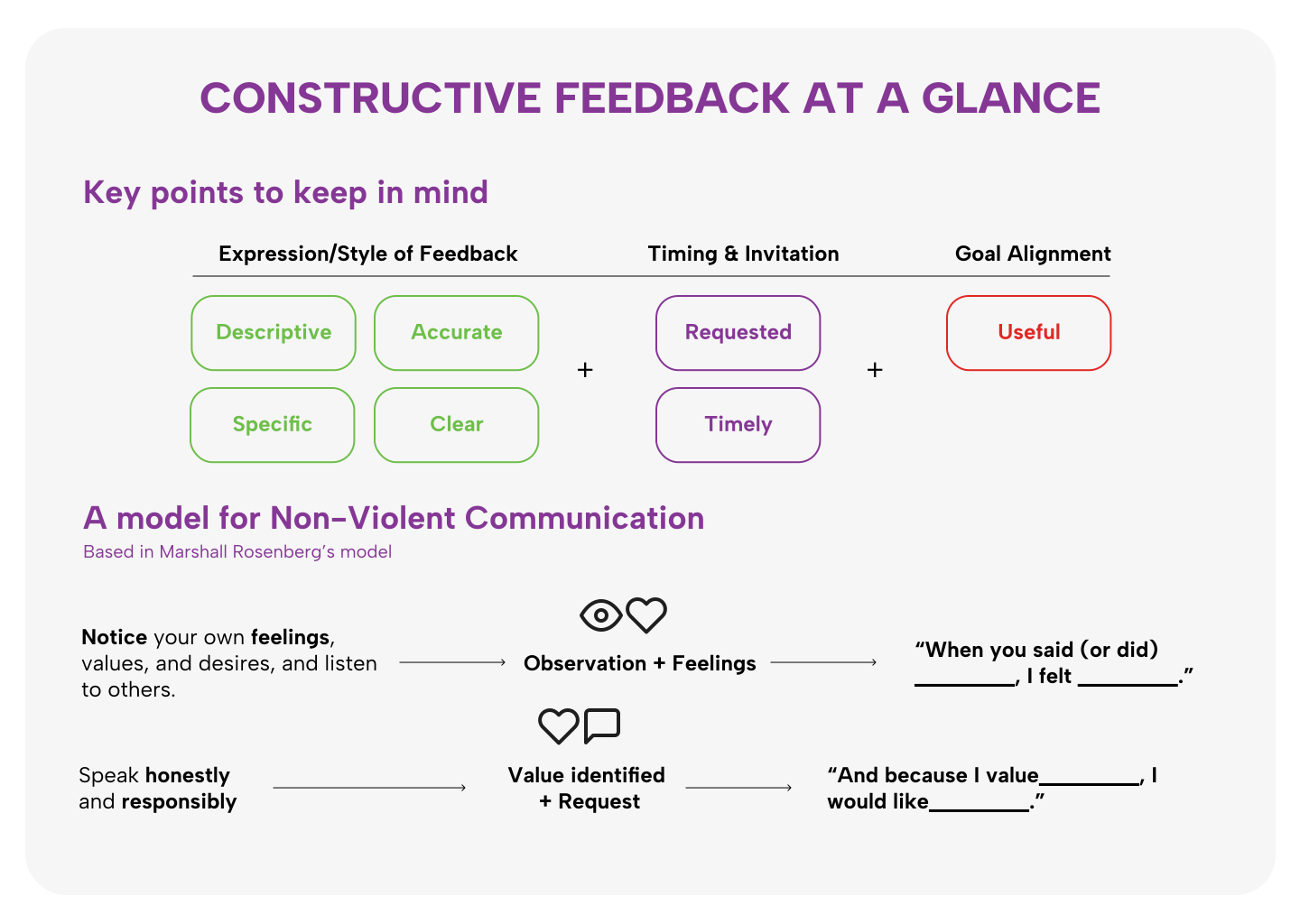
Constructive feedback is one of the most valuable aspects of field education, helping us continuously adapt, learn, and evolve towards our learning goals. Here you will find some key aspects to have in consideration while elaborating and expressing feedback.
Descriptive
Be descriptive rather than judgmental. By describing your own reaction, you leave the other person free to use the feedback as they see fit. When you use judgmental language, the person receiving feedback is likely to become defensive and “shut down” (i.e. no further learning will take place during this exchange). Use “I” language when you offer feedback. By doing so, you acknowledge that you are speaking from your own perspective, observations, perceptions and feelings. Example: “When you use the word ‘girl’ or ‘dear’, I feel put down and not recognized as an adult woman.”
Specific
Be specific rather than general. Example: instead of saying, “You are very dominating”, offer this statement “Just now, when we were deciding the issue, I felt you were not hearing what others were saying. I felt forced to accept your arguments.”
Appropriate
Feedback can be destructive when it serves only our own needs and fails to consider the needs of the person on the receiving end. What we offer must be supportive and responsible. Example: “Speaking in large groups is difficult for you, isn’t it? I appreciated the effort it took for you to make your contribution to the Board meeting. Your comments were helpful. How can we help you to continue to build your confidence?”
Requested
A Learning Covenant requests feedback on specific and clearly stated learning goals. If a student wants additional feedback, she/he/they should ask for it. If a student wants to offer feedback, she/he/they should wait to be invited to contribute it or seek permission to offer feedback at the receiver’s convenience. Feedback is most helpful when the receiver develops a framework in which constructive criticism might be offered. For example, a student may want to develop a worship feedback sheet listing the areas in which she/he/they wants feedback.
Useful
Direct your feedback toward behaviour that the person can change. Most of us find it frustrating to be reminded of shortcomings over which we have no control. Example: “I enjoyed your Children’s Time last Sunday, but I would have found it more helpful if you had used the microphone so that I could have heard the story, too.” Note the use of “I” statements in this example.
Timely
Consider the timing of your feedback carefully. In general, the feedback is most helpful when offered sooner rather than later. It is not helpful to make a quick critical comment immediately following an observed behaviour unless you are prepared to spend time with the person receiving your feedback. Example: “I’d like to offer some feedback on the process you used in Bible study tonight. Do you have time to sit down and talk about it or can we set up a time soon?” Under normal circumstances, it is better to offer constructive feedback during a regularly scheduled meeting with the Mentor or Ministry Reflection Group.
Clear
Check to ensure that you are communicating clearly. One way of doing this is to have the receiver rephrase the feedback to see if it corresponds to what you intend to convey. Example: “Let me see if I understand what you are saying to me. Was it the specific word I used in a sermon that concerns you or the general message I was trying to convey?”
Accurate
Check for accuracy. When feedback is offered in a group, both the giver and the receiver have an opportunity to check with others about the accuracy of the feedback. Is this person’s impression shared by others? Example: “In this evaluation session, someone suggested that more printed resources would have been helpful. What do others think about this idea?”
Connected to the Learning Covenant
As much as possible, limit feedback to the goals stated in the Learning Covenant. Example: “I’ve been thinking about your goal to develop your pastoral skills. When John told us about his daughter’s illness, it really seemed to throw you. Could we set aside some time at our next meeting of the Ministry Reflection Group and role-play the various pastoral responses to crises?”
A Model for Non-violent Communication
How we voice our feedback can have a great impact on how we foster constructive spaces.
Marshall Rosenberg offers an excellent model of communication for constructive feedback. Rosenberg’s model empowers people to exchange resources and resolve differences in non-aggressive ways. He advises us to speak honestly and responsibly about our own perceptions, feelings, values and desires, as well as listen to the perceptions, feelings, values and desires of others. Rosenberg’s model focuses on four essential pieces of information:
“When you said (or did) __________, I felt __________.”
“And because I value __________, I would like __________.”
This material is from Marshall Rosenberg, who is the Director of the Center for Nonviolent Communication, P.O. Box 2662, Sherman, Texas.
Check more related resources
Assessment and Evaluation
LEARN MOREEducational Philosophy
LEARN MOREWhat does the role of mentor/supervisor involve?
Guiding students through reflective learning and leadership development, offering support and resources, engaging in mutual discernment, and fulfilling agreed-upon responsibilities and reporting within the framework of the Learning Covenant.
LEARN MORE