Get inspired
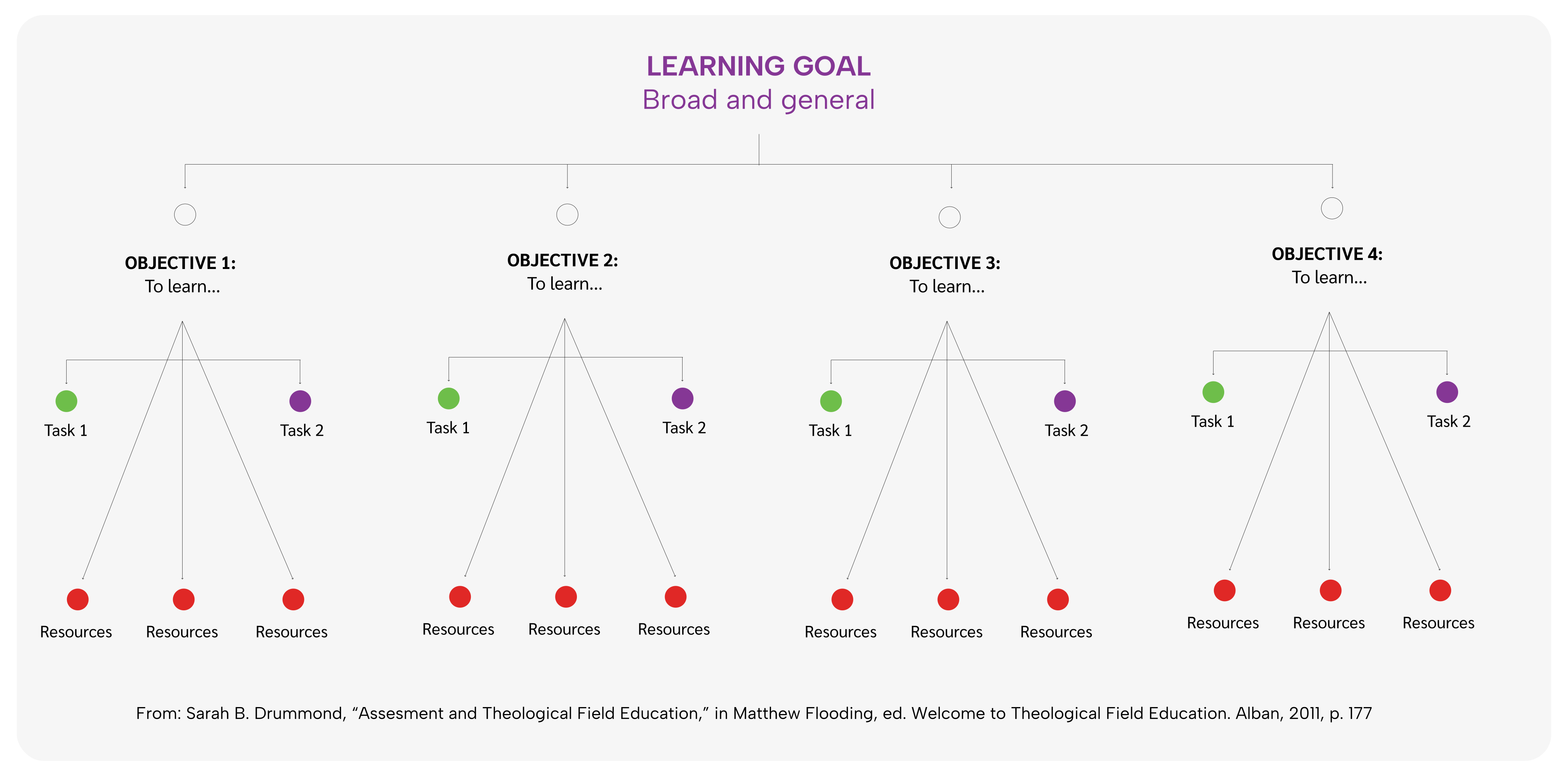
The Learning Goals and Learning Covenant are built on three fundamental parts. Below is an example of how to elaborate on them articulating specific goals, tasks, and resources to achieve them.
PART ONE
Student Information
This section outlines key information about the student, the mentor or supervisor, and the placement site.
PART TWO
Learning Goals
In this section, we will outline and explore how to establish your TFE goals, as well as the action plan that can help achieve the outcomes of the learning covenants.
General Goal
To complete the requirements of (TFE-P: Leadership in Practice & The Studio or TFE-FC: Leadership in Faith Community) with special attention to (for example, my growth as a facilitator, religious education, pastoral care, team leading, leading worship) at (name of site), in consultation and collaboration with my mentor (name).
Goal 1: To Gain Experience in Leading Bible Studies
Objective: To design, plan and take primary leadership in an educational ministry event.
Action Plan:
- Meet with the Christian Education Committee in October to discuss the possibility of a Lenten Bible study. We will discuss conducting a “needs assessment” asking such questions as “Does the congregation want a Lenten Bible study?” “What is the level of commitment to attend a Lenten Bible study?” “What are the burning issues that people are concerned about that might be addressed as topics in a Lenten Bible study?”
- Meet in November with VST faculty members responsible for religious education for their input and advice. Draw up a proposal and present it to my mentor and the Christian Education Committee.
- Determine an evaluation process by January. Design an evaluation form that addresses (a) Bible study design and content, (b) teaching skills, (c) general comments about my effectiveness as a religious teacher (theology, teaching style and delivery) and (d) suggestions for my further development as a religious educator.
- During January and February, prepare a teaching plan and an outline for each session.
- During Lent, teach the Bible study.
- Meet with my mentor after Lent to debrief the experience, review suggestions and offer ideas for “next steps” in my development as a religious educator.
Resources:
- Faculty responsible for educational ministry at the School
- The Christian Education Committee
Goal 2: To Develop Skills in Leading Public Worship with Children
Objective: To gain experience by leading “The Children’s Time” during worship.
Action Plan:
- Meet with the worship planning team and worship committee to discuss the possibility of leading “The Children’s Time” every other week during October and November.
- Meet with the Sunday school teachers in September. Ask if they might design two sessions in which they would teach me how to teach children and lead them in worship. These sessions would include resources they use, for example, how to teach Sunday school children, teaching tools, storytelling techniques, etc. Attend the two teaching sessions in October.
- Lead “The Children’s Time” every other week in October and November (at least four occasions).
- Meet with the Sunday school teachers after each occasion to debrief and receive feedback.
- Share what I have learned about working with children in worship with my mentor.
Resources:
- The faculty who teach religious education and liturgical studies at the School
- Sunday school teachers
- Resources on storytelling, teaching children and children in worship found in the School’s library
- The Sunday School Teachers, Christian Education Committee, and Worship Committee
- My mentor
Goal 3: To Learn How to Make Pastoral Visits
Objective: To attend pastoral visits as an observer and to make at least one pastoral visit on my own.
Action plan:
- Accompany my mentor on at least two pastoral visits in September and early October, one to a hospital, the other to a home, and write a verbatim on each of these visits.
- Discuss the verbatim during a reflection session with my mentor following these visits.
- Conduct one pastoral visit on my own and provide a verbatim regarding that visit to my mentor.
Resources:
- My mentor
- Faculty with experience in pastoral care
- Print resources regarding pastoral care
- The pastoral care team of the congregation
PART THREE
Learning Covenant
This section identifies the General Terms of the agreement between the student, mentor/supervisor, the site and the school. This also contains the approval of the TFE Director.
General Terms:
The student and the supervisor agree to meet for one hour weekly or two hours bi-weekly (the equivalent of 12 hours per term) to reflect theologically on the student’s progress in attaining the goals, objectives and action plans outlined in this document.
The student and the supervisor each agree to prepare a mid-point evaluation report and an end-of-term evaluation report (See Due Dates in TFE Handbook). Reports prepared will be read and signed by all parties before the reports are submitted to the Director of Theological Field Education.
Students in TFE-P: Leadership in Practice:
Commit to spending 8 – 12 hours per week in the field placement, excluding Reading Week. This includes time spent in worship/program activities and reflection with their mentor/supervisor. The total time expectation is 200 hours over two terms. This is in addition to the time spent in The Studio (PT651 and PT652).
Students in TFE-FC: Leadership in Faith Community:
Commit to spending 8 – 12 hours per week in the field placement, excluding Reading Week or a modified period in late Spring and Summer. This includes time spent in worship/program activities and reflection with their mentor/supervisor. The total time expectation is 200 hours but this can be done in two 100 period blocks. With the permission of the TFE Director, 100 hours credit may be given for one unit of CPE.
As this program focuses on the learning needs of the student, the mentor and the site agree not to encourage or require the student to take on general duties or to staff existing programs to fill site-based needs unrelated to the student’s Learning Goals as outlined in this document.
If any part of the teaching, learning or evaluation process breaks down, the Director of Theological Field Education must be notified immediately. Upon notification, a consultative process will be initiated to resolve the differences or to terminate the field placement agreement.
All pertinent policies (including harassment policies) of the Vancouver School of Theology and of the appropriate denominational authority shall be always adhered to by all persons and sites involved in the Theological Field Education program. (See TFE Handbook, Section 6).
All appropriate regional public health regulations, and health and safety regulations of the Learning Site, organization or denomination need to be followed. In the post-pandemic period, it is also important to consider the comfort level of people with whom we work and minister.
The field placement site agrees to communicate all information that may affect this agreement or the student’s Learning Covenant as soon as possible.
The student and mentor/supervisor agree to the General Terms described in this document, and any further terms of accountability appended, and to meet regularly for the equivalent of 12 hours per term for reflection on learning.
Check more related sources
Mentor and Supervisor Responsibilities and Opportunities
Mentors and supervisors, once matched and confirmed, enter a collaborative relationship with students focused on regular reflection, support, and feedback within VST’s guidelines.
LEARN MOREStudent’s Responsibilities in Relation to the Mentor
LEARN MORETheological Reflection
LEARN MORE